Roode History

Saturday, March 25, 2006

Abortion and crime - Freakonomics

I referenced something written by Father Richard John Neuhaus regarding the book "Freakonomics", I suggest that people actually take the time to read what is said. Neuhaus is setting up in blunt terms the logical consequences of the argument made in "Freakonomics" that hey, abortion may be icky, but at least it deters crime by eliminating people who may become criminals -- in this case, minority children in urban areas.

Is that what Levitt and Dubner argued? No. Let's roll the tape, starting on page 137 of Freakonomics:

By 1970 five states had made abortion entirely legal and broadly available.... On January 22, 1973, legalized abortion was suddenly extended to the entire country with... Roe v. Wade.... The Supreme Court gave voice to what the mothers in Romania and Scandinavia--and elsewhere--had lone known: when a woman does not want to have a child, she usually has good reason.... For any of a hundred reasons, she may feel that she cannot provide a home environment that is conducive to raising a healthy and productive child....
What sort of woman was most likely to take advantage of Roe v. Wade? Very often she was unmarried or in her teens or poor, and sometimes all three.... Childhood poverty and a single-parent household... are among the strongest predictors that a child will have a criminal future....
In the early 1990s, just as the first cohort of children born after Roe v. Wade was hitting its late teen years... the rate of crime began to fall.... And the crime rate continued to fall as an entire generation came of age minus the children whose mothers had not wanted to bring a child into the world. Legalized abortion led to less unwantedness; unwantedness leads to high crime; legalized abortion, therefore, led to less crime.
This theory is bound to provoke a variety of reactions, ranging from disbelief to revulsion.... The likeliest first objection is the most straightforward one: is the theory true?...
[E]arly legalizing states saw crime begin to fall earlier than the other[s].... [T]he states with the highest abortion rates in the 1970s experienced the greatest crime drops in the 1990s.... (New York City had high abortion rates and lay within an early-legalizing state, a pair of facts that further dampen the claim that innovative policing caused the crime drop.)...
To discover that abortion was one of the greatest crime-lowering factors in American history is... jarring. It... calls to mind a long ago dart attributed to G.K. Chesterton: when there aren't enough hats to go around, the problem is not solved by lopping off heads.... [O]ne need not oppose abortion... to feel shaken by the notion of a private sadness being converted into a public good....
[W]hat are we to make of the trade-off of more abortion for less crime?... For a person who is either resolutely pro-life or resolutely pro-choice, this is simple.... But let's consider a third person... [who] does not believe that a fetus is the 1:1 equivalent of a newborn... [but] for the sake of argument... decides that 1 newborn is worth 100 fetuses. There are roughly 1.5 million abortions in the United States every year... the equivalent [for this third person] of a loss of 15,000... the same number of people who die in homicides... and far more than the number of homicides eliminated... due to legalized abortion.... [E]ven for someone who considers a fetus... only one-hundredth of a human being, the trade-off between higher abortion and lower crime is, by an economist's reasoning, terribly inefficient.

Is that argument of Levitt and Dubner's fairly summarized by Domenech's "hey, abortion may be icky, but at least it deters crime by eliminating people who may become criminals -- in this case, minority children in urban areas"? No, it is not. Levitt and Dubner make it very clear that they think that abortion-on-demand is a big loser as an anti-crime policy.

Were I a trier of fact on this issue, I would conclude that Domenech's claims about the argument of Freakonomics are not only false but knowingly false, and made with deliberate and conscious malice.


MarsEdit: Easy weblog editing

Posted by Brad DeLong on March 24, 2006 at 08:57 PM in Better Press Corps, Bushisms, Moral Philosophy, Moral Responsibility, Utter Stupidity | Permalink | Comments (6) | TrackBack (0)


Friday, March 24, 2006

Absolute Convictions - Moral Decay - Abortion

"Absolute Convictions" Buffalo, Press believes, was "just the kind of place" where anti-abortion groups could attract a following. By the 1970s, the city's once-powerful unions had far fewer members and much less clout. As the gap between rich and poor grew, conservative strategists used culture wars to trump class consciousness. They linked the insecurity of blue-collar Americans to the "snooty elite" that supported abortion rights, homosexuality and gun control. Entrenched in the mainstream media, universities and government, this elite was responsible for the nation's moral decline.

A realignment occurred in the 1970s and 1980s as working-class Americans, in Buffalo and around the country, gravitated "from the brotherhood of labor to the fellowship of Christ" and from Roosevelt to Reagan

future Buffalo, New York, mayor Jimmy Griffin. "I suppose I'm a square," Griffin said around the same time, "but I see these plans to liberalize abortion as another sign of the permissiveness, the decay of our society."


The other pragmatists in this story are the patients, several of whom Press interviews at his father's clinic. Catholic "Jessica" had passed out pictures of aborted fetuses to high school classmates a few years back. Her positive pregnancy test had changed her views. She tells Press that, at age 19, "I'm just not ready to be a mom." The two others, already mothers, can't afford to add another kid's worth of expenses to their debt. To these women, abortion is not a symbol.


Truman Domestic

TRUMAN DOMESTIC

No Teenage music – kids listen to Irving Berlin "White Christmas" , Bing Crosby, Sinatra

no youth culture – huge deficit of births in depression and WWII & continuing economic

uncertainty & men away at war

WWII trends – progressive New Deal-ish – many people still remember the depression when anyone could

get poor and hungry if they were unlucky

good feeling for veterans of all classes – "Greatest Generation" shed blood in "Good War"

against Nazi racism – war movies showed all ethnic and racial groups

Investment in human capital – GI Bill

education funding job training, low-interest loan for home purchase

Democrats like Truman want to continue expanding

Republicans kill Truman's attempts to get national health care

Truman's Civil Rights Commission calls for poll tax repeal, anti-lynching,

Fair Employmment Practices Commission to root out discrimination by race

Truman also pushes for Social Security extension to more people

raise minimum wage More TVA type developments War on slums

Economic policies which push for maximum employment

rather than minimize inflation for bondholders


Domestic background – Republicans using “soft on Communism” especially after Mao takes China

"Who lost China" becomes a big Republican mantra which works very effectively

Democrats fear this still – always an EVIL ENEMY someone does not hate enough –

INTERNATIONALISM & TOLERANCE

McCarthy combines the Communist paranoia – "government is full of traitors" with

small town resentment of government bureaucracy

"elite snobs" who "think they know better than us common folks" "striped pants boys"

"Ivy Leaguers" Federal government bureaucrats "big government"


1946 election

Resentment of UNIONS 35% American workforce – with more power than ever

railroad and coal strikes hurt large parts of the nation & seem greedy and irresponsible

Unions have Communist sympathizers as Communists have been consistently for working people

Some dominated – Longshoremen on docks

Easy to tar all unions with "communism" – Walt Disney & Reagan in video

Even Truman is Angry Big Labor – John L Lewis - Coal miners – Railroads - Steel

clls them traitors – wants to "execute a few"

Post-war shortages, meat especially, as rationing ends

everyone was for the war but war production has been directed by the state with big bureaucracies,

rationing – another irritating bureaucracy - now people are eager to get back to normal life

Republicans take both houses of congress in 1946

tax cuts for upper income groups passed over Truman's veto

Taft-Hartley – anti-labor unions – outlaws closed shops which require union membership

Unions restrict "freedom of contract" as noted in SAF

if shop is not closed free-riders can get union benefits and long term loss of leverage

easy for bosses to play off non-members aganist "solidarity"


The ballance has shifted slightly and truman is not the politician FDR was

"To Err is Truman" – an unpretentions man with matter-of-fact honesty and bluntness


WOMEN 1/3 of workforce during WWII

Rosie the Riveter, Lumberjills glorified – women make good $$$

movie stars Joan Crawford Bette Davis – look like they could clock a guy

big shoulders – sinewey - tough

After war big Backlash

movie stars get top-heavy and soft – Jane Mansfield – Marilyn Monroe

Birth rate soars – traditional family values – Father Knows Best

Strong father family also fits better in a dangerous world full of evil

Dr Spock permissiveness progressive – let kids learn at their own pace with minimal compulsion –

talk to kids don't hit them – this irritates conservatives who prefer:

Old Testament Religion – father is ruler patriarchy – sets hard rules – punishes


CIVIL RIGHTS

Civil Rights – FDR gave up after failed effort to purge conservative southerners and also transformed from "Dr NewDeal" to Dr "Win the War"

Truman reacts personally and courageously Desegregates army with executive order

Previous Discrimination – Navy blacks only cooks, messmen and servants

Hollywood propaganda: – melting-pot units - opposite of WWI anti-German prejudice (except Japan)

mostly we want to cast out all prejudice – racial, religious and every other kind”

Reality: Many bases in South – Blacks from North not used to abuse – violence and riots result

“What Blacks Want” - Chorus of demands to scrap segregation o buses, streetcars, trains – most blatant and humiliating form of Jim Crow


precipitous decline of agriculture leads to massive urbanization

cotton acreage down and mechanical cotton picker

680,000 black farmers in1940 only 104,000 in 1960


“Moderate whites” cannot challenge segregation until race relations improve; but any challenge to segregation will increase racial tension so .....


NAACP - attack Jim Crow at most vulnerable point: Public Education - discrimination easy to

document – pictures of dilapidated shacks black schools and whites' new brick buildings

compare per-capita spending

Supreme Court 1944 outlaws "White Primary" 1946 – interstate commerce segregation illegal

FBI – Hoover strongly racist – Blacks only servants – increases surveillance Black organizations


Blacks registering to vote in increasing numbers – from thousands to million by 1952 -

enough for some political power – enough for margin in close elections

Truman appoints Presidential Committee on Civil Rights – call for laws against lynching

police brutality, abolition of poll tax, federal protection of voting rights,

FBI action against civil rights violations, fair employment laws,


1947 Jackie Robinson integrates Baseball

Ideology of White Supremacy anachronism in serious world (till Federalists and Murry Bell Curve)

Anthropologists & sociologists had undermined intellectual case for racial hierarchy

Nazi death camps stamped racism with crime of genocide

Rise of anti-colonialism India ( Mahatma Ghandi influences MLKing)

third world makes racism international issue

we're very worried about third world competition with Soviets


COLD WAR CONSERVATIVE RELIGION – politics molds / influences / creates RELIGION

Church – Conservative evangelicals – OLD TESTAMENT GOOD VS EVIL

form Fuller Theological Seminary Pasadena Ca

church membership 49% 1940 to 69% 1959

Billy Graham "Jesus loves Private Property" Communists "private property is theft"

comunists are dispossessing churches – "religion is opiate of the people"

Communists State owns "means of production"


Fredrick Hayek

inspiration for Bill Buckley, National Review, Federalists, Alito, Roberts

FREEDOM IS UNITARY – take away economic freedom and you inevitably take away all freedom

"Road to Serfdom" (like Marxists, has clear laws of history drawn in absolute terms)


COLD WAR was used as a tool against New Deal “positive” freedoms. In 1948 Harry Truman proposed universal health care. The American Medical Association (doctor’s union) used the spectre of “socialized Medicine” in the largest public relations campaign in American History to discredit Truman’s proposal for National Health care.

The “Freedom Train” of 1947 EXCLUDED FDR’s Four Freedoms (including freedom from want), the Wagner Act (Workers’ freedom) the Fair Employment Practices Commission (black workers’ rights). New Deal freedoms – helping the poor – sounded vaguely “socialist.” Programs like child-care for single mothers were oposed as sounding like the Soviet’s system. Cold War Economic “freedom” stopped emphasizing safety nets like Social Security, workers democracy and pluralism. In Cold War solidarity against the enemy is central so being the opposite of the Soviets was good. Anything like “socialism” was verboten. Billy Graham said that Jesus loved Private property. “private property” “nuclear families” “free enterprise” “freedom to choose” especially consumer goods – wee the foundations of what distinguished / separated us from the Soviets.

Cold war also saw a surge in religiosity – especially evangelical and fundamentalist denominations. The more moderate mainline religions lost membership or grew much more slowly. Evangelical / fundamentalist Religion that divided the world into”Good vs evil” was much more simpatico with the “zeitgeist” (spirit of the age)

Cold war religions liked “traditional women’s roles”

Cold war nuclear-scary - Soviet menace – especially “the enemy within”

TV “I led three lives” McCarthy “State Department traitors”

Community vs nuclear family “domestic” women

WWII had glorified Rosie the riveter – after war women pushed back to traditional roles US Different from other developed countries with prosperity - birth rates stay low US marry earlier – MANY more kids – more emphasis private fixes

“personal is political”


The new suburbs were the site of the reaffirmation of domesticity. Separated from work, relatives, and the social networks of cities. nuclear families which married younger, had more kids (1940 2 kids ideal – 1960 4 kids ideal) and divorced less.

Suburbs were rigidly racially segregated. Blacks were migrating from the South – 3 million in the 40’s and 50’s – 1.4 million in the 60’s. The core cities were de-industrializing – leaving poor blacks in the inner cities where their situation confirmed racial stereotypes by associating them with crime and welfare - reaffirmed “proved” the reasons for racial exclusion. To the extent that integration worked it also tended to let the “role model” blacks – businessmen and professionals - escape the old segregated black communities – increasing their difficulties. Walter Lippman warned that turning foreign policy into an “ideological crusade” – viewing every challengeto the status quo thru the lens of “Anti-Soviet” would mean “a heterogeneous array of satellites, clients dependencies, and puppets” – require intervening continuously in the affairs of nations whose policies did not emanate from Moscow and did not “fit” the simplistic dichotomy between “freedom” and “slavery.”

Lack of enthusiasm for the “freedom” vs “slavery” line – was often considered treason. Cold war ideology was a tool wielded against civil rights by white supremacists, employers against unions “traditional morality” & “traditional family” enthusiasts against homosexuals, nudists, and even women in the work force. The nuclear family with the wife staying home became the standard against which every other arrangement was measured. Academic freedom was not extended to dissent in our country while we condemned Soviet cultural rigidity. Europeans didn’t go through the Cold-war in the same way. They were under our Nuclear umbrella and many were more “socialist” than nations (like Guatemala) we attacked as “communist”

The symptoms are interesting. Europe 6 week vacation - Europeans often remark that Americans "live to work," while Europeans "work to live." The average paid vacation time in Europe is now six weeks a year. By contrast, Americans, on average, receive only two weeks. Most Americans would also be shocked to learn that the average commute to work in Europe is less than 19 minutes. EU eats slow food grown locally - not fast factory food. Cold War’s Consumer democracy in America defines self by SUV or McMansion – not quality of life – eat big macs on the way to making 1 more buck. When Billy Graham said “Jesus loves private property” McDonalds arose like a miracle. That difference is reflected in the American and European Dreams, which at their core are about very different ideas about freedom and security. The Cold War changed things for Americans. New deal , freedom has long been associated with autonomy. An autonomous person is dnot dependent on others or vulnerable to circumstances beyond his or her control. To be autonomous one needs to be propertied. The more wealth one amasses, the more independent one is in the world. One is free by becoming self-reliant and an island unto oneself. With wealth comes exclusivity, and with exclusivity comes security. The new European Dream is based on different assumptions about what constitutes freedom and security. For Europeans, freedom is found not in autonomy but in embeddedness. To be free is to have access to many interdependent relationships. The more communities one has access to, the more options one has for living a full and meaningful life. It is inclusivity that brings security -- belonging, not belongings. The American Dream emphasizes economic growth, personal wealth, and independence. The new European Dream focuses more on sustainable development, quality of life, and interdependence. The American Dream pays homage to the work ethic. The European Dream is more attuned to leisure and "deep play." The American Dream is inseparable from the country's religious heritage and deep spiritual faith. The European Dream is secular to the core. The American Dream depends on assimilation: We associate success with shedding our former ethnic ties and becoming free agents in the great American melting pot. The European Dream, by contrast, is based on preserving one's cultural identity and living in a multicultural world. The American Dream is wedded to love of country and patriotism. The European Dream is more cosmopolitan and less territorial.

APPLICANT POOL Colleges - Male Female

Published: March 23, 2006

Gambier, Ohio

A FEW days ago I watched my daughter Madalyn open a thin envelope from one of the five colleges to which she had applied. "Why?" was what she was obviously asking herself as she handed me the letter saying she was waitlisted.

Why, indeed? She had taken the toughest courses in her high school and had done well, sat through several Saturday mornings taking SAT's and the like, participated in the requisite number of extracurricular activities, written a heartfelt and well-phrased essay and even taken the extra step of touring the campus.

She had not, however, been named a National Merit finalist, dug a well for a village in Africa, or climbed to the top of Mount Rainier. She is a smart, well-meaning, hard-working teenage girl, but in this day and age of swollen applicant pools that are decidedly female, that wasn't enough. The fat acceptance envelope is simply more elusive for today's accomplished young women.

I know this well. At my own college these days, we have three applicants for every one we can admit. Just three years ago, it was two to one. Though Kenyon was a men's college until 1969, more than 55 percent of our applicants are female, a proportion that is steadily increasing. My staff and I carefully read these young women's essays about their passion for poetry, their desire to discover vaccines and their conviction that they can make the world a better place.

I was once one of those girls applying to college, but that was 30 years ago, when applying to college was only a tad more difficult than signing up for a membership at the Y. Today, it's a complicated and prolonged dance that begins early, and for young women, there is little margin for error: A grade of C in Algebra II/Trig? Off to the waitlist you go.

Rest assured that admissions officers are not cavalier in making their decisions. Last week, the 10 officers at my college sat around a table, 12 hours every day, deliberating the applications of hundreds of talented young men and women. While gulping down coffee and poring over statistics, we heard about a young woman from Kentucky we were not yet ready to admit outright. She was the leader/president/editor/captain/lead actress in every activity in her school. She had taken six advanced placement courses and had been selected for a prestigious state leadership program. In her free time, this whirlwind of achievement had accumulated more than 300 hours of community service in four different organizations.

Few of us sitting around the table were as talented and as directed at age 17 as this young woman. Unfortunately, her test scores and grade point average placed her in the middle of our pool. We had to have a debate before we decided to swallow the middling scores and write "admit" next to her name.

Had she been a male applicant, there would have been little, if any, hesitation to admit. The reality is that because young men are rarer, they're more valued applicants. Today, two-thirds of colleges and universities report that they get more female than male applicants, and more than 56 percent of undergraduates nationwide are women. Demographers predict that by 2009, only 42 percent of all baccalaureate degrees awarded in the United States will be given to men.

We have told today's young women that the world is their oyster; the problem is, so many of them believed us that the standards for admission to today's most selective colleges are stiffer for women than men. How's that for an unintended consequence of the women's liberation movement?

The elephant that looms large in the middle of the room is the importance of gender balance. Should it trump the qualifications of talented young female applicants? At those colleges that have reached what the experts call a "tipping point," where 60 percent or more of their enrolled students are female, you'll hear a hint of desperation in the voices of admissions officers.

Beyond the availability of dance partners for the winter formal, gender balance matters in ways both large and small on a residential college campus. Once you become decidedly female in enrollment, fewer males and, as it turns out, fewer females find your campus attractive.

What are the consequences of young men discovering that even if they do less, they have more options? And what messages are we sending young women that they must, nearly 25 years after the defeat of the Equal Rights Amendment, be even more accomplished than men to gain admission to the nation's top colleges? These are questions that admissions officers like me grapple with.

In the meantime, I'm sending out waitlist and rejection letters for nearly 3,000 students. Unfortunately, a majority of them will be female, young women just like my daughter. I will linger over letters, remembering individual students I've met, essays I loved, accomplishments I've admired. I know all too well that parents will ache when their talented daughters read the letters and will feel a bolt of anger at the college admissions officers who didn't recognize how special their daughters are.

Yes, of course, these talented young women will all find fine places to attend college — Maddie has four acceptance letters in hand — but it doesn't dilute the disappointment they will feel when they receive a rejection or waitlist offer.

I admire the brilliant successes of our daughters. To parents and the students getting thin envelopes, I apologize for the demographic realities.

Jennifer Delahunty Britz is the dean of admissions and financial aid at Kenyon College.

Thursday, March 23, 2006

Do they really believe Abortion is murder?

Do they really believe that abortion is murder?

Posted by Ampersand | March 21st, 2006

I really like to assume the best of everyone, even people I disagree with.

And I try hard to take what opponents say, at their word.

But sometimes it's hard.

A lot of people who favor forced childbirth for pregnant women say that they believe that an abortion, even early in pregnancy, is identical to child murder. Have an abortion, shoot a four-year-old in the head; morally, it's the same. Or, anyhow, that's what they claim to believe.

In contrast, pro-choicers tend to think that the abortion criminalization movement is motivated by a desire - perhaps an unconscious desire - to punish women for having sex.

I used to reject that latter view as a pointless ad hominem attack. Nowadays, I'm not so sure. Although I've met some rank-and-file "pro-lifers" whose policy preferences were consistent with a belief that a fetus is morally indistinguishable from a child, those folks usually have policy preferences which are totally out of step with the abortion criminalization movement as a whole.

In contrast, the leaders of the abortion criminalization movement have consistently put their political weight behind policies which make little or no sense if they genuinely think that abortion is identical to child murder. And those same leaders routinely endorse policies that make a lot of sense if their goal is to penalize women who have sex. And they've done so with the apparent backing and blessing of the vast majority of the rank and file. Let's review:

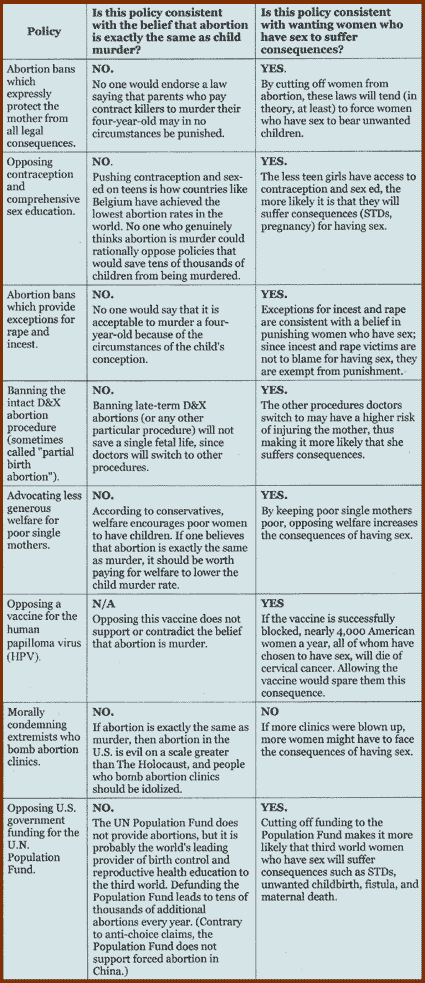
Chart of policies or positions favored by powerful anti-choice leaders

Almost none of their policies make sense if they really see no difference between the death of a fetus and the death of a four-year-old. However, nearly all their policies make sense if they're seeking to make sure that women who have sex are punished. After years of seeing this pattern repeated again and again, it's difficult to take them at their word.

UPDATE: Molly Saves The Day has several good posts along similar lines: See her posts 20 Questions - Baby-Killers Edition, which partly inspired this post; More Questions For People Who Want To Make Abortion Illegal; and Which Is It?

Wednesday, March 22, 2006

French Economy

French Take to the Streets to Preserve Their Economic Fantasy

By Steven Pearlstein
Wednesday, March 22, 2006; D01

Ah, springtime in Paris.

The sight of riot police outside the Sorbonne.

The smell of tear gas wafting along the Seine.

The sweet sounds of hypocrisy floating from the National Assembly and the Elysee Palace.

And, next Tuesday, a national strike, perfectly timed to create a four-day weekend.

What inspired this season's revolutionary festivities is a radical new law that would give employers up to two years before deciding whether to give new young employees the kind of lifetime job security conferred by French law.

To those of you brainwashed by Anglo-American market capitalism, this might appear like the sort of labor market flexibility they babble on about at meetings like this week's European summit -- the kind that might actually entice a French company to create a new job.

But when viewed through the dark prism of the French imagination, these aren't real jobs -- they're "garbage jobs" and "slave contracts" meant to undermine the birthright of all Frenchmen to be shielded from all economic risk. Give in on this, and who knows what could go next? The 35-hour workweek? The six weeks of paid vacation? State-mandated profit sharing? Retirement at age 60?

What's so galling about the French is that, in the name of equality and solidarity, they are well on their way to creating not only one of the least vibrant economies in the industrialized world, but also one of the least equitable.

The "insiders" of this economy consist of a shrinking pool of older, middle-class workers who enjoy the full panoply of worker protections. Most of them are in the public sector or heavily regulated private industries, with the rest in a dwindling number of competitive private firms.

And then there are the "outsiders." This growing pool includes the unemployed young men of the mostly immigrant suburbs who went on a rampage last year, throwing rocks and burning cars. But it also includes the children of "insiders," who tend to hang around the university until they are 24 or 25, then drift between unpaid internships, temp jobs and welfare for another five years before finally getting "inside."

You'd think that, with all that time they spend chatting away in cafes, these young "outsiders" would have figured out by now that this system, which protects and cossets the "insiders" at all costs, is sucking the innovation and vitality from the economy. But rather than supporting the reforms that might generate more jobs and more income, the outsiders have bought into the nostalgic fantasy of a France that once was, but can never be again, making common cause with the very "insiders" whose selfishness and pigheaded socialism have left them out in the cold.

That said, you can hardly blame the kids for being confused about their economic predicament.

After all, the supposedly center-right government that pushed through the new youth-employment contract is the same government that adamantly refused to give up subsidies for farmers, stepped in to prevent foreign takeovers of French companies and, just last week, demanded that Apple iPods accept music downloads from iTunes competitors (read: French competitors). But having declared, in effect, that markets cannot be trusted to generate socially and politically acceptable outcomes, the same government is now shocked to find that it doesn't have much credibility when it asks workers to trust markets when it comes to the terms of their employment.

This sort of calculated hypocrisy among the French political elite, which likes to "talk left, act right," has now completely undermined support for market capitalism. A telling poll released in January by the Program on International Policy Attitudes at the University of Maryland found that only 36 percent of French respondents felt that "the free enterprise system and free market economy" is the best system. That's the lowest response from any of the 22 countries polled and compares with 59 percent in Italy, 65 percent in Germany, 66 percent in Britain and 71 percent in the United States.

Perhaps it's no surprise, then, that Forbes magazine's latest list of global billionaires includes only 14 from France, without a single new entry this year. Germany, a country not twice its size, has four times as many, while Britain, which is about the same size, has 24.

Indeed, when you ask French university students who is the Bill Gates of France, they look at you blankly. It's not simply that they can't name one. The bigger problem is that they can't imagine why it matters, or why that has anything to do with why they can't find a good job.

© 2006 The Washington Post Company

Ike Foreign Policy

Multipple choice last class 15/17 = A 14 = B+ 13 = B 12 = B- 11= C 10 = C- 9 = D

From last class – Democrats showed first sign of later split in 1948. At their convention a young delegate, Minneapolis Mayor Hubert Humphrey's passionate speech in favor of a strong civil rights platform inspired much of the party – but caused a walkout of southern delegates clinging to segregation. They formed the Dixiecrats – led by Strom Thurmond.

Truman's strong anti-Soviet policy also caused more conciliatory elements led by former Vice-President Henry Wallace to form a separate Progressive party. This made Truman's chance to win look almost hopeless. The Chicago Tribune put out an edition with "Dewey Beats Truman" headline. But a feisty whistle stop campaign won for Truman.

These splits foreshadow later much more serious splits. The party went to a less-enthusiastic civil-rights advocate in 1952 – Stevenson. But in the 1960's the Democrats would lose the South to the Republicans over Civil Rights.

The Wallace split foreshadowed events in the 1960's and later when Democrats disillusioned by Vietnam would come to be dominated by less ferociously anti-communist New-Left-ers like George McGovern.

McCarthy

During the election campaign Ike repeats McCarthy's claims

Commies in government are serious problem Democrats refuse to fix (one typesetter in obscure bureau found to be commie)

refuses to defend General Marshall from McCarthy's slimy "communist sympathizer" charges.

Clearly understood how far below his own standards he had fallen.

One of the McCarthyites grabbed Ike's hand after Ike spoke in a show of apparent unity in Wisconsin.

Ike said he felt "dirty from the touch of the man" and that if he "puts his hand on me once again, I'm going to knock him right off the platform".


McCarthy – Ike is disgusted but unwilling to get in gutter to confront

slimy chicken-hawk opportunist liar alcoholic – IKE was a competitive man who wanted to be president but he regretted his lack of honesty and moral character the rest of his life.

Ike blamed the Press for building up and reporting on McCarthy but it would have taken someone like Ike to knock McC down.

Anti-science Anti-intellectual fervor – common in times of paranoia

Oppenheimer and Einstein – do not speak in Good versus Evil terms – NOT PATRIOTS

DO NOT WANT TO BUILD H-BOMB or SUPER prima facea case for traitor

Scientists want to know amusing and different kinds of views –

Oppenheimer knows commies (married one)

PRO-McCARTHY

Especially Catholics – know personally family persecuted by Communists in Eastern Europe

from National Journal (Alito and Federalists intellectual heirs)

Communists, in fact, invented the term "McCarthyism," and devised most of the ideology that went with it.... "[A]nti-McCarthyism" as a movement... broadest and most successful the Communists have ever catalyzed in this country.... the Liberals .. automatically exclude[s] effective anti-Communist action. And they cannot go along when the community sets out to do something about its Communists.

Eisenhower's sending the 82nd Airborne Division to Little Rock to protect civil rights:

By what right, according to what law, do these heavily armed combat teams of the first nuclear age "pentomic" division remain and act in Arkansas? Where is the statute... that entitles these soldiers... to quarter themselves on the municipal property of the Little Rock school system? to obstruct traffic...?... to forbid citizens to assemble together?... to club and stab citizens slow to respond to shouted orders? What law authorized the rude braggadocio of General Walker?... The truth is... [t]here is no law, the bayonets have displaced the law in Little Rock.... General Walker is in Little Rock as the commander of an army of occupation... enforcing unconditional surrender. No sensible person will excluce the possibility of a domestic crisis so extreme.... [W]ould it not be prudent to reflect that when guns are released from control by law, we can never be sure what direction they will point in?

The magazine's doubts about the Fifteenth Amendment:

Although the states qualify voters, Art. I, Sec. 4 of the Constitution grants to Congress the power to make or alter... regulations concerning elections for senators and representatives. The Fifteenth Amendment prohibits the denial or abridgement of the right to vote "on account of race, color, or previous condition of servitude."... [H]onest men may differ as to the wisdom and expediency of these grants [of power to the federal government.]...

And Frank S. Meyer on the virtues of McCarthyism:

The peculiar horror of this presidentiad of Eisenhower... [is that] everything merges into one dull blur.... It cannot grasp as real the looming threat of dehumanization that proceeds from the iron tyranny of Soviet Communism or from the soft blandishments of the Welfare States and World Government.... [T]he Era of Moderation could be fairly launched only after the censure and destruction of McCarthy. So long as there was a voice so powerful... insisting that the contemporary world presented an absolute choice between good and evil... the anesthesia could be only imperfectly administered.... What Joe McCarthy was... can[not]... be judged by weighing in the balance the niceness of his discriminations or that tactical acuity of his actions.... His was not a common role. It comes to few men to play it--sometimes to a poet, sometimes to a politician sometimes to someone of no particular position.... Joe McCarthy, who bore witness against the denial of truth that is called moderation, and died for it: "He was a prophet."...

Posted by Brad DeLong on December 21, 2005 at 05:12 PM in Better Press Corps, History, Moral Resp

IKE ADMINISTRATION When Ike comes in he hires Nitze / Dulles types Anti-Communist Crusaders

US Information Agancy - purged of non-true-believers – no communist authors –

supposed to demostrate our "free speech" values

Intelligence from State Department cowed – Dulles gives McCarthyites free reign

leaders often get only "tough response" info which feeds / matches their cold-war paranoia

CIA UNLEASHEDby Ike – can't use nukes, against large costly "military-industrial-complex"

ran for president worried that Isolationist & small-government Taft would win

covert action cheap option –

Problem: CIA collects intelligence about problems and fixes same "problem"

no oversight, no checks and balances, no transparency lotsa bad intelligence

gung-ho-anti-communist is the coolest and only way to be safe.

Favorable intelligence on anyone resembling possible "communist sympathizer" might end a career

"Moderates" were chastened by the experience of the China Hand's who accurately forecast

Mao would defeat the corrupt and incompetent Chang Kai Chek.

Nitze NSC 68 1950 – any means are justified because we're fighting EVIL

maybe reasonable about Stalin & Mao - but other situations get simplistic analysis

Lippman – to view every challenge to status-quo thru lens of "Soviet challenge" leads to

"heterogeneous array of satellites, cients, dependents and puppets"

intervene continually in the affairs of nations whose politics didn't emanate from Moscow -

not subsumed in dichotomy between "slavery and freedom"

Dulles deeply-religious mystical streak self-righteous "Roll back" Russians – total BS

No support for State Department independence – unleash McCarthy-ites on them

Instead of an open exchange of information with those with local knowledge having voice

top down operation.

Dulles demands "positive loyalty" – absolute support for Dulles position – Fires Kennan

not possible to do independent thinking - scared to say anything but party line – China hands

Anti-communist Crusade

Truman scared the country to get support for containment

McCarthy & others fan into hysteria

Korea & Vietnam reinforce focus on & fear of agression


NUKES AND KOREA Ike rejected the idea of limited nuclear war – although he used the threat of newly invented tactical nukes – could be fired in artillery - to get the Chinese to negotiate seriously on Korean war. Korea was still dragging on after 2 years of negotiations during which we suffered half our casualties.

When planners tried to make plans for limited nuclear war Ike forbid it. Ike "most subtle and brutal strategist of the nuclear age" ..... insisted on planning only for total nuclear war. His purpose was to make sure that no major war at all would take place."

Ike knew that calculations made in peacetime have no relevance to the passions of war

Henry Kissinger will be theorist of "imited nuclear war" – model for Dr Strangelove

YES! We can Nuke!

Since Nuclear weapons were unusable in Cold War confrontation with Russia, and Ike desperately wanted to avoid more ground wars like Korea we needed other options.

Ike decides we needed CIA covert action – radically expanding the scope of CIA action.


In Europe we worked to separate the Stalinist left from the social-democratic left.

Eurocentric view subordinates the rest of the world to European concerns (Vietnam, Iran)

Latin America MUCH less nuance – any hint of "reform" or resistance to our corporations

easily associated with Communism – often by people with vested interest in deception..

Europe US moderate democratic-progressive & Marshall plan

Early hint of Russian problems - East Germany riots in 1953 – massive emigration to West

Stalin dies 3 months after Ike Inaugurated

New leadership Berea - wants to put relations on less confrontational basis

Berea offers unified democratic Germany if not in NATO

Ike and Dulles in cold-war mode – refuse Bereqa's advances – he is ousted

Khruschev takes over

1956 - Secret speech denouncing Stalin and cult of personality

Mao – with his own cult of personality – is offended

1956 Hungary uprising – they have believed Americans do not lie – Dulles "roll back" political lies kill many Hungarians

VIETNAM French are in denial – refuse US urging to give up Vietnam.

Vietnamese and Algerians are not colonies, they are part of the noblest country in the world.

Vietnamese students learn French History ...."our ancestors the Gauls....."

SEATO – South-East Asia Treaty Organization – not much use

Right after WWII Army on the ground and far-east hands of State Department told everyone

Ho would win in the long run.

Ho's repeated entreaties for an alliance with us against China were ignored.

Pro-European State Department officials much more listened to outmaneuvered the Asia specialists.

We needed French help in NATO so we supported French efforts to regain influence in Vietnam.

Army sensible preconditions for aid to French also stupidly ignored

We did urge the French to promise Vietnamese self-determination –

but we sent them $billions in arms and supplies anyway

Almost Everyone at the top of the foreign policy hierarchy believed in simplistic theory

Russians ruled a monlithic Worldwide-Communist-Conspiracy with the

Chinese and Vietnamese following their orders. Tell story often enough ...

1954 - fall at Dien Bien Phu Vietnam – Ike helps but avoids involvement

might have intervened at but Brits wouldn't go along – need multilateral support .

We had agreed with French-fighting-in-Vietnam' and English-fighting-in-Malasia

that we wouldn't accept a separate armistice but .....

Eisenhower listened to the Military less than Truman had – far less tolerance for dissent since he had been a soldier.

State Department (Dulles) ruled on Vietnam - didn't listen to information from low levels of state.

Believed McCarthyite crap

Those who had actually talked to Ho might be aware of his saying "better to eat 20 years of American sh*t than 1000 years of Chinese sh*t". Ho was desperate for ally against the Chinese. Vietnam had been resisting China for thousands of years. War between China & Viets would break out when we left

– many years and a few million deaths later.


Military Industrial (Congressional) complex – First and last speech -

Ike takes "congressional" out at last minute

Congress loves pork – Trent Lott gets boat contracts for district Navy does not want

Committee on Present danger – later – analysis of their numbers imply that people should be

crawling over Berlin wall east to west – Carlyle Group & Saudis now

When Sputnik goes up "experts" in pay of defense industries produce Gaither report

we need to spend huge amounts on defense – deficit spending -Grand expectations 419

JFK starts yapping about "missile gap"

Ike had proposed "open Skies" to reduce paranoia with Russians – we could each see each others' weapons and preparations - they refuse

our U2's can see we are way ahead but

Ike doesn't want to reveal our technology or irritate Russians with intrusion


National Defense Education Act – huge scholarships for engineering and science

I float on this tide into expensive university

Berkley 1960's – complicity in "Military Industria Complex" Multiversity

Draft recruiters on campus visceralizes – Kent State – Now – Pacifism vs Kill em all

Helps educate Student protestors of 1960's who attack Cold-War Consensus during Vietnam

undermine the faith in government which is needed for good education system for all

Democratization of higher education – Ike Doubles higher educ $$$

My dad can afford a Suburban home + rise in class = move to Suburbs = more conservative vote

Iran - Churchill before WWI OIL key to war and economics – Iran and Iraq

After WWII most old colonies Brits know they are are too poor to run an empire

and realize people do not appreciate being occupied

BUT in Iran making lots of $$

Mossadegh is TIME Magazine man of the year in 1951

for bringing democracy to the Middle East and representing former colonies asserting rights.

Rabid anti-colonialist / nationalist - wants to take control of Iran's resource- parliament unamimous

Anglo-Iran oil in1948 makes 61 million pounds - Iran gets 9 million – Brit govt 28 million pounds

US had just given Saudi's 50% money & control of their oil – tell Brits to "be reasonable"

Mossadegh educated in West and believes deeply in democracy –

very scrupulous about allowing freedom of expression including demonstrations

one of few non-corrupt third-world leaders – takes no $$

Insists Shah be constitutional monarch like Britain

Shiite – public displays of emotion are cool – self flagellation –

Mossadegh faints, cries – and winks at the doctor – theatrical leader

British oil run by "Whiff of Grapeshot" school – make no compromise with "natives"

"We got a contract at gunpoint – bad luck for you poor guys"

Truman absolutely forbade British plans to invade & overthrow Iranian government – too too stupid

"We don't know the country" – colonialism is dead – our rhetoric is "freedom"

Brits go to Security Council – Mossadegh comes and charms Americans and world-

compares nationalization of oil to American revolution – wins in Security Council

World Court throws out Briitsh case

Churchill back in as PM

Brits plan coup – Mossadegh hears – closes embassy

Truman says we don't overthrow sovreign governments "CIA could become American Gestapo"

Very true of both early CIA & KGB – war-ish-frame-of-mind much dumber Soviet foreign ministry

KGB works with head-cases – Castro & Idi Amin & Angola & Etheopia

Iran and Mossadegh love US – young US missionary martyr in democratic revolution 1919

"Iran's Lafayette" Like Tolstoi and Lincoln – we stand for self determination and democracy

Ike's intelligence – often planted by Dulles Brothers (Alan at CIA, John Foster at State dept)

US Embassy filled with gung-ho covert-operatives instead of Iran experts from State Dept

describes mob rule with thuggish commie Mosadeq supporters (Paid by Kermit) running rampant &

pro-Shah mobs angry at Mossagegh (paid by Kermit)

Reality - Kermit Roosevelt is paying mobs, bribes editors, reporters, army factions

these reports mold Eisenhower's view like Cheney's alum tubes and uranium reports & Bolton's thuggism

Dulles – Communists ready to take over through Mossadegh

ignores reality from agents on ground

General Schwarzkopf Senior establishes first constabulary unit to get rid of Shah's enemies

talks young wimp-Shah into signing illegal order to remove Mossadegh

Dulles claims Mossadegh wants a dictatorship when in reality he is scrupulously respectful of freedom

demonstrations and free speech and other democratic niceties

British & Dulles tell Ike they have offered Iranians control of oil industry - not what agreement says

Ike approves but does not investigate in detail - so he will have deniability

always afraid he will leak secrets in press conferences

We send Shah to airport – he flies to safety after first coup attempt fails

American Ambassador fake complaint to Mossadegh – Pro Mossadegh mobs bother Americans

Mossadegh tells his supporters to be quiet – not go to street

tells police to keep his people quiet – unilaateral disarmament

Second attempt succeeds - Insert Shah – who rules with quite a bit of torture.

Suppresses all political opposition –

religious fundamentalism only outlet for dissent & source of social services

For some reason many Iranians are still paranois and pissed at years of torture, oppression and theft. Who can understand these crazy Muslims?

Ike says coup "seemed like a dime novel" – COWBOY STORIES of Ike's youth - On to Guatemala


Looks like a success for 25 years – most Americans no idea what happened

We help Shah get nuclear power – buy $$$billions weapons – surrogate in Gulf

threaten Iraq - we don't like Sadaam – support Kurdish rebels Iraq

border agreement advantage to Iran – grievance for 1980 war

America takes Israel's side starting 1967 – even more in 1972 Yom Kippur war – first oil boycott

aggravation rises in Arab World

1979 – Shah flees, as he had during US coup in 1953 –

Iranian students remember history - grab embassy & take hostages after US lets in Shah

Election outcome changes – Reagan – super-Cold-Warrior wins ....


Guatemala – revolution in 1944 overthrows General-brutal-dictator

Democracy takes root Arbenz amazingly un-corrupt

starts paying United Fruit Company (UFCO) for fallow land at the value they declared on their taxes

this is much more conservative than US land-reform policy in Japan

Ike believes in orderly process for decisions but

Dulles does not listen to State Dept experts – pushed aside by CIA activists

embassies full of cowboys

UFCO – Dulles was their lawyer – hire PR firm –

pay $25,000 for Guatemala-is-Commie horror story (like MLK etc)

bound to look like official government document

finds way into official government documents - State Department White Paper – UN speeches

(function of analysts in CIA develops later)

"Guatemala ruled by Communists determined to sieze the Panama Canal"

Distributed to Hearst International News Service & 1000 "opinion leaders" & Time Magazine

Henry Luce – first says "American Century" in 1940

child of Chinese Missionaries

Fires correspondent in China for truth – "Making of the President 1960"

CIA buys weapons and plants them so they can be found & reported

Coup is mostly planted stories in Newspapers to create a state of Terror in the country

Planes with leaflets – just throw out hand grenades - but big publicity

Bloodless coup – Arbenz flees

but 200,000 deaths over next decades

Che Guevara – in Guatemala during coup – outraged that moderate democrats have been deposed

meets Castro in Mexico City – goes to Cuba as committed revolutionary

unusually bloodthirsty executing anyone connected to previous government

as simple-minded as the anti-commies - - BOTH SIDES GET SUPER STUPID

COMMON SYMPTOM – HATE SCIENCE – OPEN DEBATE - transparency



American Theocracy

Review by ALAN BRINKLEY

Four decades ago, Kevin Phillips, a young political strategist for the Republican Party, began work on what became a remarkable book. In writing "The Emerging Republican Majority" (published in 1969), he asked a very big question about American politics: How would the demographic and economic changes of postwar America shape the long-term future of the two major parties? His answer, startling at the time but now largely unquestioned, is that the movement of people and resources from the old Northern industrial states into the South and the West (an area he enduringly labeled the "Sun Belt") would produce a new and more conservative Republican majority that would dominate American politics for decades. Phillips viewed the changes he predicted with optimism. A stronger Republican Party, he believed, would restore stability and order to a society experiencing disorienting and at times violent change. Shortly before publishing his book, he joined the Nixon administration to help advance the changes he had foreseen.

Phillips has remained a prolific and important political commentator in the decades since, but he long ago abandoned his enthusiasm for the Republican coalition he helped to build. His latest book (his 13th) looks broadly and historically at the political world the conservative coalition has painstakingly constructed over the last several decades. No longer does he see Republican government as a source of stability and order. Instead, he presents a nightmarish vision of ideological extremism, catastrophic fiscal irresponsibility, rampant greed and dangerous shortsightedness. (His final chapter is entitled "The Erring Republican Majority.") In an era of best-selling jeremiads on both sides of the political divide, "American Theocracy" may be the most alarming analysis of where we are and where we may be going to have appeared in many years. It is not without polemic, but unlike many of the more glib and strident political commentaries of recent years, it is extensively researched and for the most part frighteningly persuasive.

Although Phillips is scathingly critical of what he considers the dangerous policies of the Bush administration, he does not spend much time examining the ideas and behavior of the president and his advisers. Instead, he identifies three broad and related trends — none of them new to the Bush years but all of them, he believes, exacerbated by this administration's policies — that together threaten the future of the United States and the world. One is the role of oil in defining and, as Phillips sees it, distorting American foreign and domestic policy. The second is the ominous intrusion of radical Christianity into politics and government. And the third is the astonishing levels of debt — current and prospective — that both the government and the American people have been heedlessly accumulating. If there is a single, if implicit, theme running through the three linked essays that form this book, it is the failure of leaders to look beyond their own and the country's immediate ambitions and desires so as to plan prudently for a darkening future.

The American press in the first days of the Iraq war reported extensively on the Pentagon's failure to post American troops in front of the National Museum in Baghdad, which, as a result, was looted of many of its great archaeological treasures. Less widely reported, but to Phillips far more meaningful, was the immediate posting of troops around the Iraqi Oil Ministry, which held the maps and charts that were the key to effective oil production. Phillips fully supports an explanation of the Iraq war that the Bush administration dismisses as conspiracy theory — that its principal purpose was to secure vast oil reserves that would enable the United States to control production and to lower prices. ("Think of Iraq as a military base with a very large oil reserve underneath," an oil analyst said a couple of years ago. "You can't ask for better than that.") Terrorism, weapons of mass destruction, tyranny, democracy and other public rationales were, Phillips says, simply ruses to disguise the real motivation for the invasion.

And while this argument may be somewhat too simplistic to explain the complicated mix of motives behind the war, it is hard to dismiss Phillips's larger argument: that the pursuit of oil has for at least 30 years been one of the defining elements of American policy in the world; and that the Bush administration — unusually dominated by oilmen — has taken what the president deplored recently as the nation's addiction to oil to new and terrifying levels. The United States has embraced a kind of "petro-imperialism," Phillips writes, "the key aspect of which is the U.S. military's transformation into a global oil-protection force," and which "puts up a democratic facade, emphasizes freedom of the seas (or pipeline routes) and seeks to secure, protect, drill and ship oil, not administer everyday affairs."

Phillips is especially passionate in his discussion of the second great force that he sees shaping contemporary American life — radical Christianity and its growing intrusion into government and politics. The political rise of evangelical Christian groups is hardly a secret to most Americans after the 2004 election, but Phillips brings together an enormous range of information from scholars and journalists and presents a remarkably comprehensive and chilling picture of the goals and achievements of the religious right.

He points in particular to the Southern Baptist Convention, once a scorned seceding minority of the American Baptist Church but now so large that it dominates not just Baptism itself but American Protestantism generally. The Southern Baptist Convention does not speak with one voice, but almost all of its voices, Phillips argues, are to one degree or another highly conservative. On the far right is a still obscure but, Phillips says, rapidly growing group of "Christian Reconstructionists" who believe in a "Taliban-like" reversal of women's rights, who describe the separation of church and state as a "myth" and who call openly for a theocratic government shaped by Christian doctrine. A much larger group of Protestants, perhaps as many as a third of the population, claims to believe in the supposed biblical prophecies of an imminent "rapture" — the return of Jesus to the world and the elevation of believers to heaven.

Prophetic Christians, Phillips writes, often shape their view of politics and the world around signs that charlatan biblical scholars have identified as predictors of the apocalypse — among them a war in Iraq, the Jewish settlement of the whole of biblical Israel, even the rise of terrorism. He convincingly demonstrates that the Bush administration has calculatedly reached out to such believers and encouraged them to see the president's policies as a response to premillennialist thought. He also suggests that the president and other members of his administration may actually believe these things themselves, that religious belief is the basis of policy, not just a tactic for selling it to the public. Phillips's evidence for this disturbing claim is significant, but not conclusive.

THE third great impending crisis that Phillips identifies is also, perhaps, the best known — the astonishing rise of debt as the precarious underpinning of the American economy. He is not, of course, the only observer who has noted the dangers of indebtedness. The New York Times columnist Paul Krugman, for example, frequently writes about the looming catastrophe. So do many more-conservative economists, who point especially to future debt — particularly the enormous obligation, which Phillips estimates at between $30 trillion and $40 trillion, that Social Security and health care demands will create in the coming decades. The most familiar debt is that of the United States government, fueled by soaring federal budget deficits that have continued (with a brief pause in the late 1990's) for more than two decades. But the national debt — currently over $8 trillion — is only the tip of the iceberg. There has also been an explosion of corporate debt, state and local bonded debt, international debt through huge trade imbalances, and consumer debt (mostly in the form of credit-card balances and aggressively marketed home-mortgage packages). Taken together, this present and future debt may exceed $70 trillion.

The creation of a national-debt culture, Phillips argues, although exacerbated by the policies of the Bush administration, has been the work of many people over many decades — among them Alan Greenspan , who, he acidly notes, blithely and irresponsibly ignored the rising debt to avoid pricking the stock-market bubble it helped produce. It is most of all a product of the "financialization" of the American economy — the turn away from manufacturing and toward an economy based on moving and managing money, a trend encouraged, Phillips argues persuasively, by the preoccupation with oil and (somewhat less persuasively) with evangelical belief in the imminent rapture, which makes planning for the future unnecessary.

There is little in "American Theocracy" that is wholly original to Phillips, as he frankly admits by his frequent reference to the work of other writers and scholars. What makes this book powerful in spite of the familiarity of many of its arguments is his rare gift for looking broadly and structurally at social and political change. By describing a series of major transformations, by demonstrating the relationships among them and by discussing them with passionate restraint, Phillips has created a harrowing picture of national danger that no American reader will welcome, but that none should ignore.

Alan Brinkley is the Allan Nevins professor of history and the provost at Columbia University.